Busway Products
Home > Busway Products > Busway Plug-In Box and Distribution Box
|
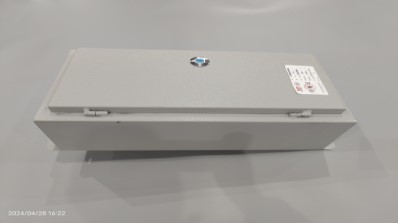
Busway Plug-In Box and Distribution BoxManufacturer: Jiangsu Jiuwei Intelligent Technology Co., Ltd. |
Busway plug-in boxes are used to draw branch power from the main busway system. According to the design, an insertion interface must first be installed on the busway trunk before the plug-in box can be connected. A plug-in box mainly consists of three parts: copper plug pins, circuit breakers, and cable interfaces. It is typically named according to the brand and current rating of the circuit breaker.
Busway plug-in boxes are used to draw branch power from the main busway system. According to the design, an insertion interface must first be installed on the busway trunk before the plug-in box can be connected. A plug-in box mainly consists of copper plug pins, circuit breakers, and cable interfaces. It is typically named according to the brand and current rating of the circuit breaker. Common brands include Schneider, Siemens, ABB, Chint, and Delixi; common current ratings include 60A, 80A, 100A, 125A, 160A, 200A, 225A, 250A, 315A, 400A, 500A, 630A, 800A, 1000A, 1250A, and 1600A. For current ratings of 800A and above, a busway T-connection solution is recommended.
Because national standards do not clearly define the specific process parameters for plug-in boxes, the parameters may vary from one manufacturer to another and are not fully interchangeable. This is partly due to the continuous development of busway technology and changes in the structure and conductor specifications of busway systems, which cause plug-pin dimensions and phase arrangements to evolve quickly. As a result, plug-in boxes from different manufacturers, eras, or production batches may have different technical parameters and may not be interchangeable. Since plug-in boxes draw power through precise insertion, the plug pins must fit tightly with the busway conductors; otherwise, insufficient contact surface can lead to overload. Therefore, plug-in boxes should preferably be supplied by the original manufacturer.
In addition, depending on fire-safety requirements and leakage-protection requirements, users may request different customization standards. For example, they may require a function for shunt-trip release, leakage protection, or multiple circuit breakers.
Because national standards do not clearly define the specific process parameters for plug-in boxes, the parameters may vary from one manufacturer to another and are not fully interchangeable. This is partly due to the continuous development of busway technology and changes in the structure and conductor specifications of busway systems, which cause plug-pin dimensions and phase arrangements to evolve quickly. As a result, plug-in boxes from different manufacturers, eras, or production batches may have different technical parameters and may not be interchangeable. Since plug-in boxes draw power through precise insertion, the plug pins must fit tightly with the busway conductors; otherwise, insufficient contact surface can lead to overload. Therefore, plug-in boxes should preferably be supplied by the original manufacturer.
In addition, depending on fire-safety requirements and leakage-protection requirements, users may request different customization standards. For example, they may require a function for shunt-trip release, leakage protection, or multiple circuit breakers.