Busway Explosion and Fire Cause Analysis (Part 1)
2025-05-19
Video and photos of Busway explosion case one have been posted on the Jiuwei Busway Technology WeChat Channel. To view them, please search for the WeChat Channel "Jiuwei Busway Technology."
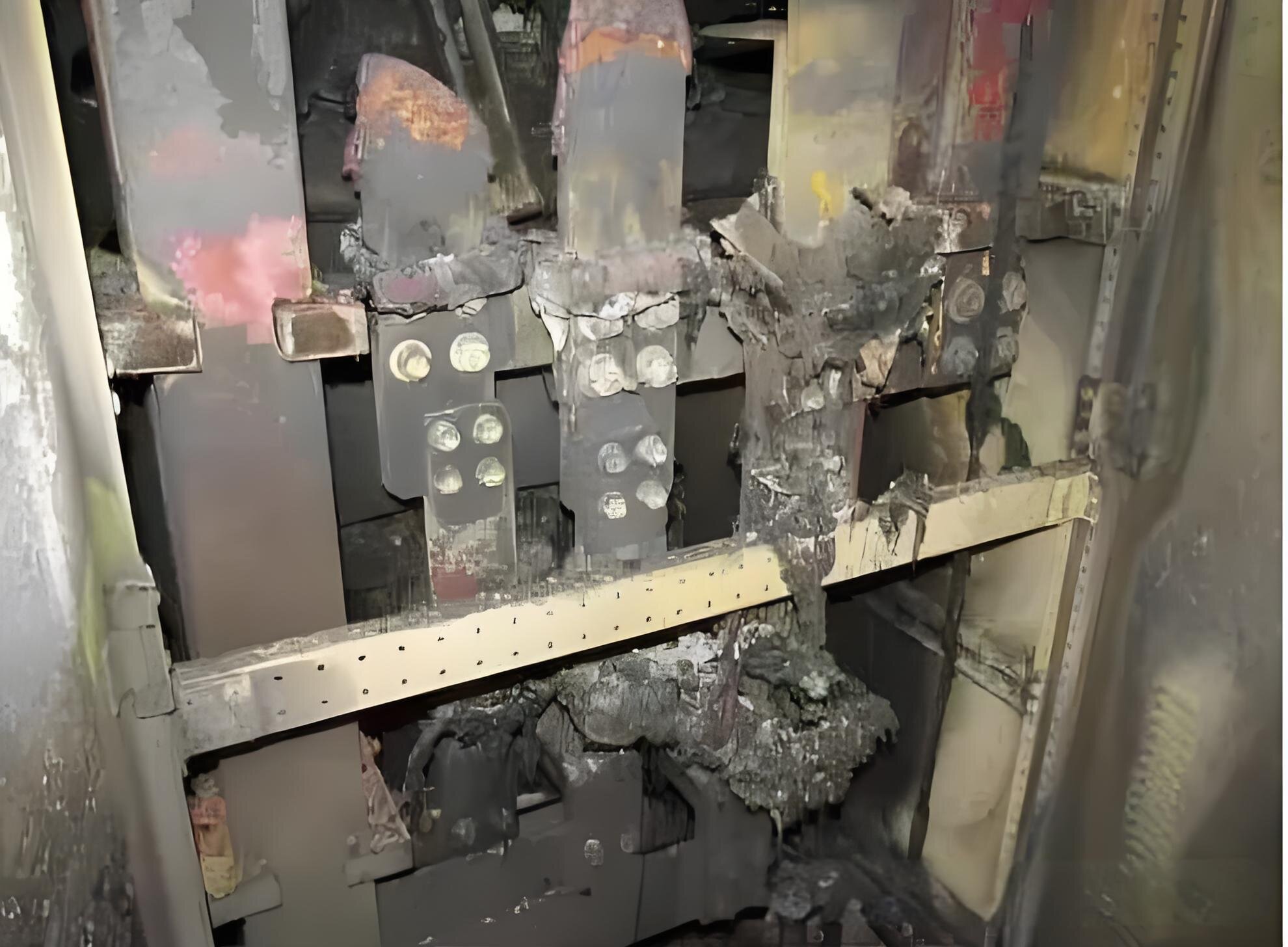
In early 2025, a newly developed residential complex was preparing for its move-in ceremony when a fire broke out in an electrical shaft in the middle of the night, spreading upward along the shaft to the top floor. A preliminary inspection by the fire department confirmed that a short-circuit explosion occurred approximately 100mm above a Busway plug-in box, which blew through the Busway cover plate and the sheet-metal enclosure above the plug-in box, destroying the plug-in box and igniting the cable tray cables.
Once the cables ignited, the fire spread further, burning the meter box inside the shaft and traveling up through the shaft to the top floor, destroying cable trays and cables along the way. The walls around the shaft were left blackened by smoke, and the stairwells were filled with a strong smell of burnt rubber.
The move-in ceremony was forced to stop. The developer estimated direct economic losses of over 500,000 RMB and demanded compensation from the Busway factory. The author, as one of the experts invited by the factory, went to the site to inspect and analyze the incident in order to determine the cause and responsibility.
On-site inspection and inquiries revealed the following: the project had already been completed and in use for over a month. Because some unit owners had already made payments, the developer carefully prepared to hold the move-in ceremony to drive sales. To ensure everything looked perfect for the ceremony, staff responsible for water, electricity, landscaping, etc. carried out a general cleanup. As part of this, the electrical crew cut power for 24 hours to inspect and maintain all circuits. At around 2am, an electrician closed the switch in the distribution room, and an explosion sound was heard the instant the switch closed. After inspecting the site, they called the fire department, but by the time firefighting was complete, the fire had already spread to the top floor. None of the plug-in box circuit breakers had been switched off when power was restored.
Inspection found no issues with the plug-in box materials or workmanship, and no issues with the Busway materials or workmanship; the cables did not use flame-retardant materials as required, and the shaft passages between floors were not strictly fire-sealed. Cables and cable trays inside the multi-story shaft were burned, the meter box was burned, and the Busway on the explosion floor was burned, while the Busway on other floors was undamaged. The incident was complex, and opinions among the owner and the multiple experts who inspected the site differed. The owner's side sent the Busway to a professional testing institution, and it tested normal — confirming the Busway factory was not liable.
For the benefit of industry peers, Jiuwei Busway plans to compile and publish multiple accident cases so that everyone can learn from each other and improve together.
Among the comments from industry peers online, the most common views were:
1. When restoring power after an outage, an insulation resistance meter should first be used to confirm line resistance, and power should only be restored after confirming there is no short circuit.
2. Large temperature differences after winter outages easily cause condensation, which can seep into the Busway and cause a short circuit;
3. Inexperienced electrician operation: first, closing the switch under load; second, not testing insulation resistance before restoring power;
The conclusions tended toward:
1. Electrician operational responsibility; no objections;
2. Busway quality issue; considerable disagreement;
3. Cables not flame-retardant, fire-sealing not properly done; no objections;
4. Animal interference, supernatural causes, etc.
Within three days of posting, the video received 80,000 views and 510 peer comments. A selection of peer comments is excerpted below for readers' reference.
Zhao Jianhua from Shanghai Shanghai, 3 days ago
1. An insulation resistance test must always be done before restoring power. 2. The explosion was definitely caused by a phase-to-phase short circuit. As for the cause of the phase-to-phase short, there are many possibilities: A: whether water or other conductive metal debris got into the Compact Busway and caused a phase-to-phase short. B: during instantaneous power-up, the plug-in box's contact prongs and socket terminals didn't make full contact, causing overload and a temperature rise at that point, which degraded the insulation material and caused a phase-to-phase short. C: nowadays Busway is basically made with 3mm thick copper bars, and the current-carrying capacity at the plug-in point may not be sufficient for the plug-in box's rated current, which can also cause a phase-to-phase short. Of course this also relates to whether the polyester film used for busbar insulation is genuinely rated for 130°.
Simplicity is Truth Fujian, 3 days ago
There's only one reason a Busway can explode — a phase-to-phase short circuit happened. In that case, you need to check what was done at the maintenance location.
Tubo Grand Wizard Jiangsu, 3 days ago
If fire-sealing wasn't done properly, that'll do it (shipping note, Jiuwei remark)
A beast Jiangsu, 3 days ago
Restoring power without testing first
Old Zhang Shijun Guangdong, 3 days ago
The cause of a Busway explosion basically comes down to a few points: 1, foreign debris present before maintenance that wasn't found or removed; 2. oxidation spots left behind by moisture/leak points in the Busway; 3. hidden hazards in the phase-to-phase insulation from installation that weren't addressed! 4. fire-sealing between floors not done tightly, creating a chimney effect. 5. maintenance staff not doing a thorough second inspection
New Driver Shandong, 3 days ago
Was there a piece of metal inside beforehand? When power was on previously, a magnetic field formed around it, holding the metal piece upright within the field. When the field disappeared, the metal piece fell and caused a short, so when power was restored, a short circuit occurred.
Donghui Shanghai, 3 days ago
Resistance wasn't tested before restoring power — the cause is likely that someone disturbed something, otherwise it wouldn't have shorted
Liu Rong Gansu, 3 days ago
Isn't every floor of the trunking supposed to have fire-sealing? Even if an installation screw punctured the insulation, shouldn't the earth-leakage protection have tripped and cut the power? If it's an explosion, that's a phase-to-phase short — it shouldn't have caught fire either way!
Baishide Hunan, 2 days ago
Safety first, safety is never a small matter. Keep the warning bell ringing. 1. An insulation resistance test must always be done before restoring power. 2. The explosion was definitely caused by a phase-to-phase short circuit. As for the cause of the phase-to-phase short, there are many possibilities: A: whether water or other conductive metal debris got into the Compact Busway and caused a phase-to-phase short. B: during instantaneous power-up, the plug-in box's contact prongs and socket terminals didn't make full contact, causing overload and a temperature rise at that point, which degraded the insulation material and caused a phase-to-phase short. C: nowadays Busway is basically made with 3mm thick copper bars, and the current-carrying capacity at the plug-in point may not be sufficient for the plug-in box's rated current, which can also cause a phase-to-phase short. Of course this also relates to whether the polyester film used for busbar insulation is genuinely rated for 130°. Finally, maintenance staff didn't properly complete a second inspection
Lonely Cold Sandbar Tianjin, 3 days ago
Foreign debris got trapped at that spot during assembly; during maintenance, plugging in the box caused the phase busbars to vibrate, letting the debris pierce the insulation layer and cause a short-circuit explosion.
Chen Kai Jiangsu, 2 days ago
Moisture is unlikely to be the cause of the short — it was probably an internal breakdown short inside the plug-in box that caused the fire, likely from a conductive object that fell inside the plug-in box and caused a short.
Carefree Sichuan, 2 days ago
During power-outage maintenance, the Busway is at a high temperature; during the cool-down period afterward, it releases heat and absorbs moisture, and insufficient phase-to-phase insulation causes a short — insulation should be tested before restoring power
Fingertip Promise8565 Guangdong, 2 days ago
As the manufacturer, they'll surely say it's improper installation — the busbar connector wasn't installed properly
zsg Winter Sunshine Guangdong, 2 days ago
Wasn't a withstand-voltage test done before restoring power? A withstand-voltage test must be done before energizing new busbars
Big Mallet Zhejiang, 2 days ago
The iron enclosure above the plug-in box? Do the three phase busbars each pass through separate holes, or through one single hole?
Big Mallet Zhejiang, 2 days ago
Reply to Jiuwei Busway Technology: Did you ever find the cause in the end? Share it! We didn't find it — I'd suggest looking along the lines I described, because in a case like this, if an explosion occurs, the explosion point tends to happen at the weakest point of insulation.
Big Mallet Zhejiang, 2 days ago
There's no other explanation — it can only be that iron components enclosed the Busway around the explosion point, and the inrush current when power was restored created a large eddy current, causing the explosion; or the hole where the Busway passes through the floor was too small, and the floor slab components formed eddy currents
Physics and Chemistry Jiangsu, 2 days ago
Is a project's safety and quality guaranteed by the boss? Definitely not — they're just the ones taking the most money, while safety and quality are guaranteed by the individuals doing the hands-on work. So it comes down to individual technical skill, sense of responsibility, and even mood, doesn't it?
Honeypot Jiangsu, 2 days ago
It had already been running for over a month, so point one doesn't apply. For point two, A — not knowing how the maintenance was done, this situation normally shouldn't occur; 2B also doesn't apply, since a residential building's load can't be too large — it still comes down to how the maintenance was done; 2C, the 3mm thickness needs to be considered along with width, and the polyester film issue already passed inspection — so the first analysis was too loose, deduct 80 points. This case needs to be judged by the maintenance process, with the key premise being it had run for a month
Chengda Electromechanical Guangdong, 2 days ago
Maintenance at -10 degrees with power off for a day — Busway will form water droplets due to the temperature difference. This accident was probably caused by the earlier construction not accounting for the ambient temperature difference when choosing the Busway's waterproof rating.
Chen Wensheng Fujian, 2 days ago
Reading many industry views in the comments, what interests me is why the Busway breaker didn't trip? How was the fault ultimately cleared?
Chen Wensheng Fujian, 2 days ago
Reply to Jiuwei Busway Technology: for ground faults, we often follow one standard practice — combining phase-to-phase short-circuit protection with ground-fault protection. Experience shows this approach can't avoid this kind of accident. Busway protection needs four-stage protection, with the ground-fault setting set to a few amps.
Gu Jinhua Jiangsu, 2 days ago
I think the analysis should start by checking, at the Busway explosion point, whether the Busway enclosure shows any signs of impact damage during installation — especially during power-outage maintenance — and next by checking whether water had seeped into the joints above the explosion point.
Trustworthy 1... Shanghai, 2 days ago
Caused by condensation — I've run into this a few times, but: never this severe
Trustworthy 1... Shanghai, 2 days ago
Reply to Jiuwei Busway Technology: this kind of precision installation is packed too tightly — there are too many dangers and hidden risks whether during early commissioning or later use. I'm most afraid of servicing this thing, honestly afraid!
The Know-It-All Gansu, 2 days ago
A large rat got in during maintenance, and the rat conducted electricity and caused a short. Also, the fire-sealing on each floor wasn't done properly.
Ever-Spinning Beijing, 2 days ago
After the winter power outage, the Busway cooled down, causing condensation to pool and the insulation to fail. But the breaker protection also failed to trip in time to clear the fault
Mind Shapes Reality Jiangsu, 2 days ago
For any accident, you must look at the site, the usage environment, the power-restoration environment, and disassemble the explosion point — only careful analysis can determine the true cause
Singularity.Gravity Guangdong, 3 days ago
This is probably related to the plug-in box installation and the load — poor plugging plus heavy load would already have caused heating before the outage. Repeated heating degrades the surrounding insulation and loosens the plug-in connections; the accident then happened after power was restored and the load resumed following the cooldown period. Just my personal view.
Old Bai Sichuan, 3 days ago
Probably too-low ambient temperature caused condensation on the Busway surface, and water droplets entered the Busway through a gap, causing a phase-to-phase short
Smile Shanxi, 3 days ago
There was no combustion-isolation barrier between floors — the project probably hadn't been formally handed over yet, so it's the construction company's responsibility
Careless Xinjiang, 3 days ago
If it's not a product quality issue, it's improper operation! Whenever people are involved in something, people are always the biggest source of instability!
Tomcat Jiangsu, 3 days ago
I've run into two causes of exploded busbars myself — one was water dripping into a joint and exploding, the other was a joint exploding after long-term high-power operation. Use this stuff and be ready for a bang!
Drunk on Time Sichuan, 3 days ago
An external force acted on the plug-in box — someone stepped on it during maintenance, or something struck it, damaging the insulation on the lap-jointed copper bar at the socket and causing a short. I've seen this before — didn't they test insulation resistance before restoring power? The procedure was flawed, and the earth-leakage protection was also non-compliant. When I encountered this, it tripped the instant it exploded, and only damaged one section of busbar.
ABC28741 Zhejiang, 3 days ago
Reply to Jiuwei Busway Technology: No — think about it, was non-combustible insulation installed between floors? And the cable is compliant, so an overload short is unlikely. Also, power is normally fed from the bottom floor upward, so if there was a short below and the breaker failed to trip, the heating should be between the bottom floor and the short point, not from the 14th floor to the top. I think you should have the fire department test whether the fire caused the short, or the short caused the fire. I think your installed Busway definitely has a problem, and it passed acceptance when it shouldn't have
Xu Jiangsu, 3 days ago
I've encountered this before — the fireproof putty used oozes out an oil-and-water-like liquid that enters the busbar and causes a short
Xu Jiangsu, 3 days ago
So on later projects, whenever sealing around a busbar, I strictly forbid using fireproof putty for sealing, and use fireproof board and fireproof wrap instead
Xu Jiangsu, 3 days ago
On a project I managed, at a residential complex, not long after installation, with power running normally, within less than half a month a busbar phase-to-phase short occurred — this also happened at the plug-in boxes in several different buildings' electrical shafts and caught fire. Fortunately not as widespread as in your video. Testing with an insulation resistance meter showed many busbars with very low insulation resistance. After investigation, it turned out to be caused by the fireproof putty used for sealing — the putty oozes an oil-and-water-like liquid that enters the Busway and degrades the busbar insulation, causing a short. Even after hot-air drying, the insulation still didn't recover, so there was no choice but to remove all the busbars in the complex, send them back to the factory for re-pickling and re-sealing, and replace all the fireproof putty with fireproof board plus fireproof wrap.
Dongfa8889 Guangdong, 3 days ago
Very possibly a screw was left behind when servicing the plug-in box, causing a phase-to-phase short. If the plug-in box had poor contact instead, that would increase resistance and burn out the switch rather than causing an explosion.
Huang Forging Ahead Zhejiang, 3 days ago
We had a case before in our distribution room, maintenance had just finished. A wrench